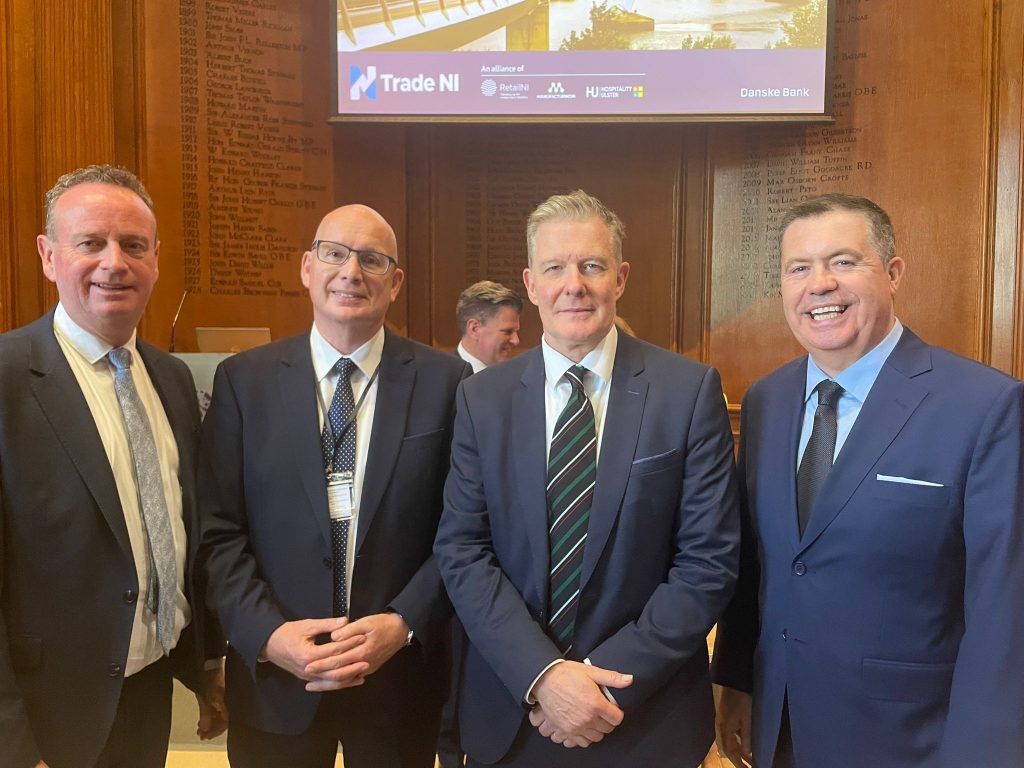
Newry Chamber President, Conor Patterson and CEO, Michael Savage travelled to Westminster on Wednesday 13th May for two days of engagements aimed at lobbying the UK and Irish Governments on key issues relating to Greater Newry’s economic future.
They attended ‘Trade NI’s Advancing Northern Ireland’s Economic Future Event’ at Surveyor’s House in Westminster on the 13th and later that evening attended the Trade NI Reception hosted by the Irish Embassy in London, where the Newry Chamber Team spoke at length with Ambassador Martin Fraser about the need for a more structured approach to the Shared Island Fund as a vehicle for the Irish Government to become a development partner in the North.
On Thursday 14th May, Conor and Michael met with officials from the Migration Advisory Committee Secretariat at the Home Office to discuss the potential development of a cross-border workers work permit for EU citizens resident in the Irish Republic, based on the current ETA exemption database.
If implemented, the permit could potentially permit between 4-6,000 EU workers domiciled in the Republic to cross the border to work in Border Counties of the North and help alleviate workforce shortages for businesses in key sectors across Greater Newry.
Trade NI is an alliance of Retail NI, Manufacturing NI and Hospitality Ulster and Newry Chamber was part of a delegation of around 200 business leaders, ministers and key decision-makers to outline the argument for the targeted use of taxation levers to unlock growth in the Northern Irish economy.
At the centre of this year’s event, sponsored by Danske Bank, was policy paper, Advancing Northern Ireland’s Economic Future, produced with BDO Northern Ireland.
The report highlights the need for targeted action on the cost of doing business, skills and entrepreneurship, with a particular emphasis on how tax policy can be used to address challenges facing the NI economy.
It calls on the UK government to adopt a co-ordinated approach to competitiveness and combine fiscal interventions with energy cost reform.
Conor Patterson, President of Newry Chamber said:
“It was very important for Newry Chamber to be represented at the Trade NI Event which presented us with an opportunity to promote the Greater Newry Area and network with key stakeholders, policymakers and add our voice to the call from NI business representatives for targeted action from the UK Government on the cost of doing business, skills and entrepreneurship and how tax policy can be used to address the economic challenges we face in the North.”
“The event at the Irish Embassy presented us with an opportunity to engage at length with Ambassador Martin Fraser, who has been a strong advocate of the Shared Island Fund, on the need for a more structured approach to the Fund as a vehicle for the Irish Government to become a development partner in the North and help us unlock potential for all-island economic growth by addressing key infrastructure deficits, particularly wastewater.”
Michael Savage, CEO of Newry Chamber added:
“We used the time in London to meet with officials from the Secretariat for Parliament’s Migration Advisory Committee to discuss the potential for the development of a cross-border workers work permit for EU citizens resident in the Irish Republic, based on the current ETA exemption database.”
“The ETA exemption database provides the ideal platform on which to build a work permit for EU workers domiciled in the Irish Republic who want to work in the North and return home across the border each day.”
“We outlined to officials how this employer sponsored permit could potentially unlock access to between 4-6,000 cross-border workers for business across the border counties of the North who are struggling to recruit staff in certain sectors and in return provide a return to the UK Government in tens of millions of pounds through PAYE and National Insurance payments alone.”
“We are at the very early stages of discussion on this proposal, and we agreed to engage with Home Office officials in the coming months to stress test the model and socialise the concept at political level at Westminster, Stormont and the Oireachtas.”